


 Cart
Cart
 sales@molnova.com


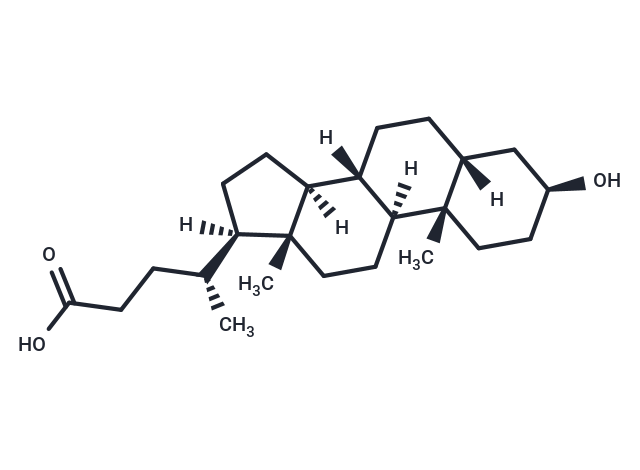
Isolithocholic Acid
CAS No. 1534-35-6
Isolithocholic Acid( —— )
Catalog No. M34789 CAS No. 1534-35-6
Isolithocholic Acid (3-Epilithocholic acid) (β-Lithocholic acid) is an isomer of Lithocholic acid.
Purity : >98% (HPLC)
 COA
Datasheet
HNMR
HPLC
MSDS
Handing Instructions
COA
Datasheet
HNMR
HPLC
MSDS
Handing Instructions
| Size | Price / USD | Stock | Quantity |
| 2MG | 185 | Get Quote |


|
| 5MG | 353 | Get Quote |
|
| 10MG | 522 | Get Quote |
|
| 25MG | 799 | Get Quote |
|
| 50MG | 1076 | Get Quote |
|
| 100MG | 1422 | Get Quote |
|
| 500MG | 2853 | Get Quote |
|
| 1G | Get Quote | Get Quote |
|
Biological Information
-
Product NameIsolithocholic Acid
-
NoteResearch use only, not for human use.
-
Brief DescriptionIsolithocholic Acid (3-Epilithocholic acid) (β-Lithocholic acid) is an isomer of Lithocholic acid.
-
DescriptionIsolithocholic acid (β-Lithocholic acid) is an isomer of Lithocholic acid. Isolithocholic acid, a bile acid, is formed by microbial metabolism of Lithocholic acid or Lithocholic acid 3α-sulfate.
-
In VitroIsolithocholic acid at 0.01 % does not inhibit spore germination and outgrowth of CF5 and M120, but it significantly inhibits at the higher concentration (0.1 %). Isolithocholic acid (0.00003 %) prevents growth of CD196, M68, CF5, 630, and BI9 and significant decreases strains CF5, BI9, M120, and 630 in toxin activity. Isolithocholic acid (0.0003 %) makes that all strains displays a significant decrease in toxin activity, except for R20291 and M120.
-
In VivoThe levels of fecal Isolithocholic acid shows obvious decreases from day 28 onward in the high fat diet (HFD) group compared with rats fed a normal diet.
-
Synonyms——
-
PathwayProteasome/Ubiquitin
-
TargetEndogenous Metabolite
-
RecptorEndogenous Metabolite
-
Research Area——
-
Indication——
Chemical Information
-
CAS Number1534-35-6
-
Formula Weight376.57
-
Molecular FormulaC24H40O3
-
Purity>98% (HPLC)
-
SolubilityIn Vitro:?DMSO : 28.57 mg/mL (75.87 mM; Ultrasonic )
-
SMILES[H][C@@]1(CC[C@@]2([H])[C@]3([H])CC[C@]4([H])C[C@@H](O)CC[C@]4(C)[C@@]3([H])CC[C@]12C)[C@H](C)CCC(O)=O
-
Chemical Name——
Shipping & Storage Information
-
Storage(-20℃)
-
ShippingWith Ice Pack
-
Stability≥ 2 years
Reference
1. Batta AK, et al. Transformation of bile acids into iso-bile acids by Clostridium perfringens: possible transport of 3 beta-hydrogen via the coenzyme. Hepatology. 1985;5(6):1126-1131.?
molnova catalog



related products
-
trans-trans-Muconic ...
trans-trans-Muconic acid is a urinary metabolite of benzene.
-
2-Oxovaleric acid
2-Oxovaleric acid is a keto acid found in human blood.
-
Alanylphenylalanine
Alanylphenylalanine (Ala-phe) is a compound isolated from the brainstem of calves.
